Article
Native PHP in 2026: Build Web, Mobile & Desktop Apps Using One Language
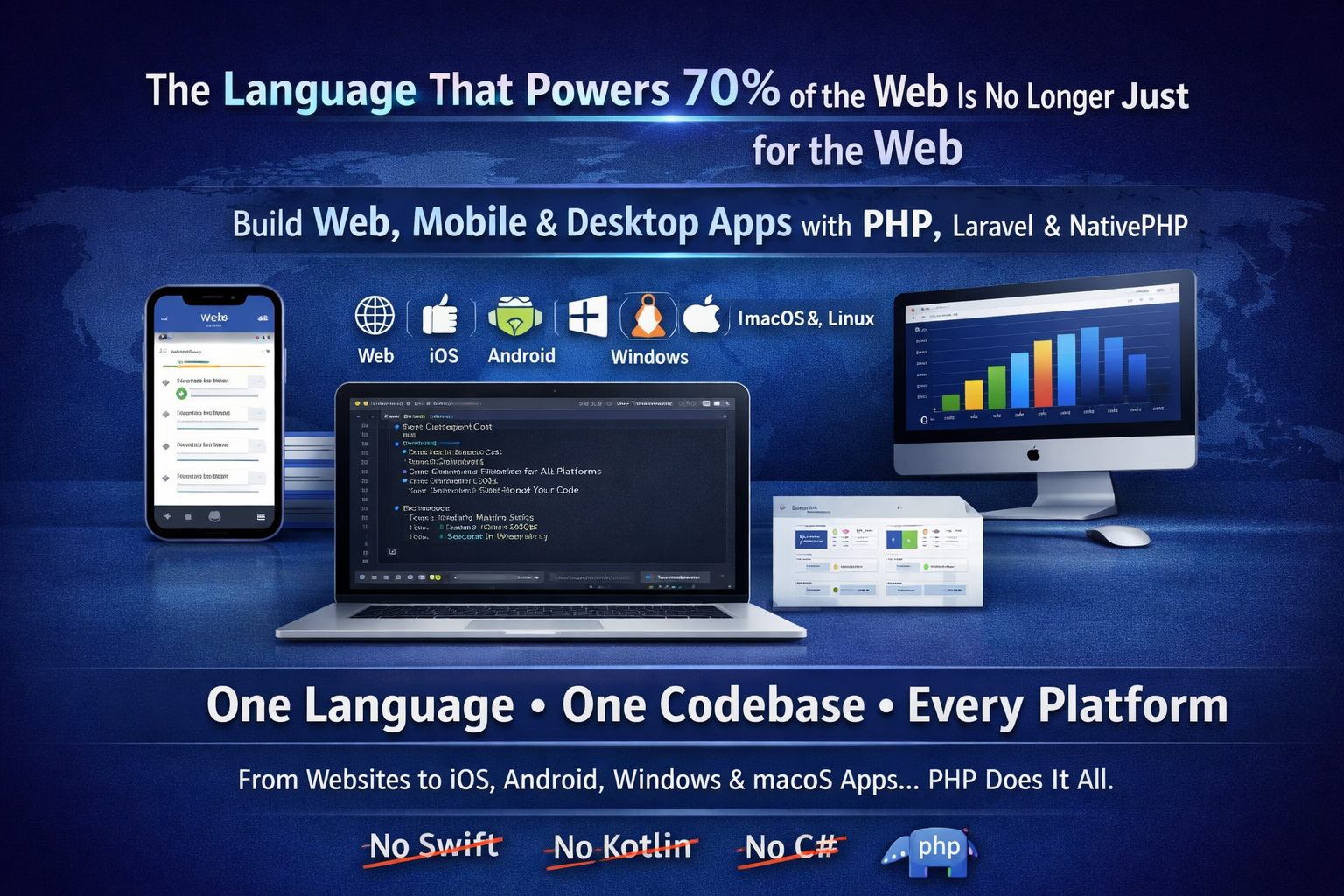
The Programming Language That Powers 70% of the Web Is Entering a New Era
For more than three decades, PHP has been the silent engine behind a huge portion of the internet. From small personal blogs to enterprise platforms, PHP has powered millions of websites across the world.
In fact, over 70% of the web still runs on PHP in some form.
But something exciting is happening.
PHP is no longer limited to building websites. A new wave of tools and frameworks is allowing developers to use PHP to build mobile apps, desktop applications, and web platforms — all with the same language.
Welcome to the era of Native PHP development.
From Web Language to Cross-Platform Powerhouse
For many years, PHP was mainly known as a server-side scripting language used to build dynamic websites.
Developers used it for:
-
Content management systems
-
E-commerce platforms
-
APIs
-
Backend services
Popular platforms like WordPress and frameworks such as Laravel helped PHP dominate the web development world.
However, developers who wanted to build mobile apps or desktop software usually had to learn completely different technologies, such as:
-
Swift for iOS
-
Kotlin for Android
-
C# for Windows applications
This meant multiple teams, multiple codebases, and higher development costs.
Now that is changing.
What Is Native PHP Development?
Native PHP development is a modern approach where PHP becomes the main language for building applications across multiple platforms.
Instead of writing separate applications for
-
Web
-
Mobile
-
Desktop
Developers can create one core codebase that powers all platforms.
This shift has been made possible thanks to tools like NativePHP, which allows developers to build native applications using PHP.
Why This Is a Big Deal
The biggest advantage of Native PHP is efficiency.
Instead of managing three separate projects, businesses can maintain one unified system.
Here are some major benefits.
Faster Development
Developers can reuse up to 80% of their existing code, especially when using frameworks like Laravel.
This significantly reduces development time.
Lower Development Costs
Maintaining a single codebase can reduce development costs by 60–70% compared to building separate applications for every platform.
Easier Maintenance
When everything runs from a single codebase:
-
Bug fixes happen faster
-
Updates are simpler
-
Security patches are easier to deploy
PHP 8.5: The Performance Upgrade
A major reason PHP is expanding beyond web development is the evolution of the language itself.
The latest version, PHP 8.5, introduces powerful improvements that make PHP faster and more modern than ever.
Some key improvements include:
-
Improved JIT compilation
-
Faster execution compared to older versions
-
Cleaner syntax with modern language features
-
Better memory efficiency
In many real-world scenarios, modern PHP performance is now competitive with platforms like Node.js.
This performance boost makes PHP suitable not only for web servers but also for mobile and desktop environments.
Mobile App Development with PHP
One of the most exciting developments is the ability to create mobile applications using PHP.
Using NativePHP, developers can build apps for:
-
iOS
-
Android
These apps can access device features such as:
-
Camera
-
GPS
-
Push notifications
-
Sensors
Even better, developers can still use the full Laravel ecosystem, including:
-
Eloquent ORM
-
Queues
-
Events
-
API integrations
This means PHP developers can build mobile apps without learning entirely new programming languages.
Desktop Applications with PHP
NativePHP also opens the door to desktop application development.
Developers can build applications for:
-
Windows
-
macOS
-
Linux
This is especially useful for creating:
-
Internal company tools
-
Admin dashboards
-
POS systems
-
CRM or ERP software
-
SaaS desktop clients
By using PHP across web, mobile, and desktop, businesses can maintain one unified development ecosystem.
One Codebase, Multiple Platforms
The biggest promise of Native PHP is cross-platform development with a unified architecture.
For example, a Laravel application might have shared components like:
-
Business logic
-
Database models
-
API services
These can power:
-
A web dashboard
-
A mobile app
-
A desktop client
All from the same backend.
This approach dramatically reduces development complexity.
Why This Matters for Developers
For the millions of PHP developers worldwide, this shift is incredibly important.
It means PHP skills are no longer limited to web development.
Developers can now expand their expertise into:
-
Mobile application development
-
Desktop software development
-
Cross-platform systems
Without abandoning the tools and frameworks they already know.
The Future of PHP Development
PHP has come a long way since its early days in the 1990s.
What started as a simple scripting tool has evolved into a modern, high-performance programming language capable of powering entire ecosystems.
With tools like NativePHP and improvements in PHP 8.5, the language is entering a new chapter.
One where developers can build web platforms, mobile apps, and desktop software using the same language.
And that might be the biggest evolution PHP has seen yet.